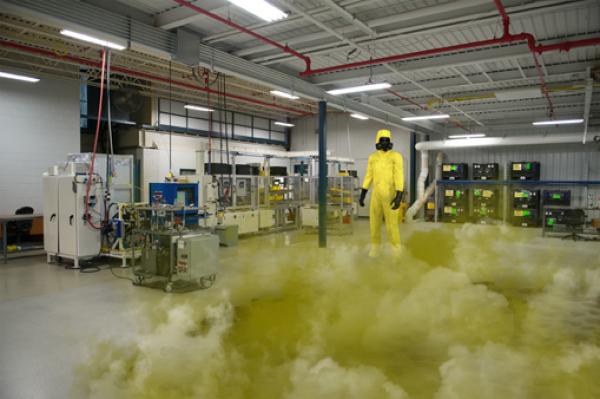
Hazardous Materials – also known as hazmat or dangerous goods – are defined as substances that pose health and safety risks to humans and the environment. Each type of hazardous material has varying degrees of danger and risk. Examples include explosives, compressed gasses, flammable liquids, flammable solids, oxidisers and organic peroxides, toxic materials, infectious substances, radioactive materials, and corrosive materials. If you’re a firefighter in training who would like to understand more about the handling and management of hazardous material risks, then read this article about EMCARE’s firefighting course in Hazmat Awareness and Operations.
Take A Firefighting Course that Focuses on Hazardous Materials
In order to protect the public from any harmful consequences of improperly handled hazardous materials it is vital that there are trained personnel who have the skill to manage these accidents carefully and efficiently. These dangerous substances can cause injury or death to humans and animals as a result of their toxic, flammable, irritating, and corrosive qualities. South Africa’s Hazardous Substances Act 15 of 1973 provides for the “prohibition and control of the importation, manufacture, sale, use, operation, application, modification, disposal or dumping of such substances and products.” In order to enforce these policies, EMCARE offers firefighting courses that focus on hazmat awareness and operations for those looking to enter into careers as first responders.
Take A Firefighting Course With EMCARE
Established in 1999, EMCARE has been training first responders in health, safety and medical training for more than a decade. With branches in Polokwane, Johannesburg, Durban, Port Elizabeth, Hoedspruit and Cape Town, EMCARE is a reputable South African company with a long list of successful, accredited courses including the hazmat firefighting course. For those who wish to prepare for the worst rather than hope for the best, EMCARE is a wonderful platform to learn about the theoretical and practical applications of health and safety procedures. EMCARE offers life-changing preparational classes in the following:
- Emergency and medical courses
Basic First Aid
First Aid Level 1, 2 and 3
CPR and AED
HIV AIDS Awareness - Healthcare Courses
Thogomelo SP – Psychosocial Support Course - Health and Safety Courses
Health and Safety Induction
General Health and Safety
Health and Safety Representative
OHS Act
OHS Workshop
COIDA
Health and Safety Supervisors - Fire and Hazmat Courses
Basic Fire Awareness
Basic Firefighting Course
Advanced Firefighting
Fire Fighter 1 SP & Hazmat Awareness SP
Fire Fighter 2 SP & Hazmat Operations SP
Hazardous Material Handling Course - Rescue Courses
Breathing Apparatus
Advanced Breathing Apparatus
Confined Space Entry - Handtool Operator Courses
Chainsaw Operator Basic
Chainsaw Operator Intermediate
Chainsaw Operator Advanced
Brush Cutter Operator
Hazardous Materials in Your Daily Life
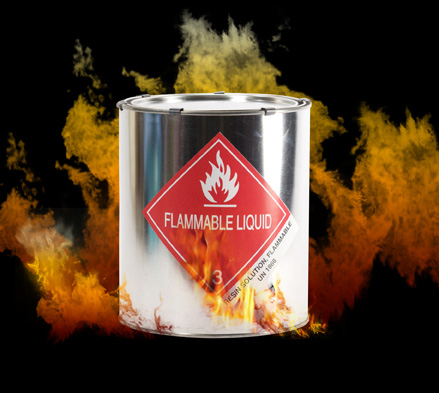
Many of us come across hazardous materials in our daily lives without realising the risk involved. Exposure to these substances and chemicals – like petrol, metal and chemical spills – can cause long-term and short-term effects that vary according to the concentration of the substance. Some substances are more diluted than other purer substances. However, it is still worthy to note that there are products around you that can be of danger to you, your family, your coworkers and even your animals – so read the list below to see examples.
- Lighters
- Aerosol cans
- Paint
- Disinfectants
- Battery fluids
- Dry Ice
- Acid
- Solvents
- Pesticides
- Mercury
- Lead
- Aluminium
- Petrol
- Caustic substances
- Glue
Although these materials do not seem as though they could directly cause harm to you, these substances can become explosive or flammable when placed in specific environments. Other substances are also able of causing death if ingested or swallowed. In the case of mistaken ingestion, explosion or flesh contact with one of the above substances, it is necessary to call a trained responder such as the brave people who have studied EMCARE’s firefighting course.
Characteristics of Hazardous Materials
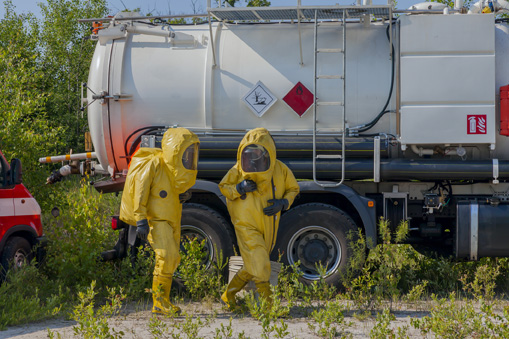
By identifying what kind of hazardous waste is present or dangerous, it becomes easier to determine how to handle the situation at hand. Safety procedures are created in accordance with the classification of hazardous materials. Students learning how to deal with hazmat awareness and operations will be taught to identify the substances according to 4 principle characteristics:
- Ignitability
Ignitable materials can catch fire or spontaneously combust – if ignited, these liquids or solids will burn vigorously and dangerously. Ignitable substances generally have a flashpoint of fewer than 60 degrees celsius, meaning that this substance gives off sufficient vapour to ignite in the air at less than 60 degrees Celcius. Ignitable solids are also capable of catching fire through chemical changes, absorption, moisture and friction even at normal temperatures. - Corrosivity
Acids and bases with pH levels less than or equal to 2, and or greater than or equal to 12,5 are corrosive. This means that it is capable of breaking down and corroding metal, such as storage tanks, metal containers and barrels. Corrosive substances are also capable of damaging and burning skin. - Reactivity
Reactive substances can cause explosions, release toxic fumes and gases. These substances usually have unstable reactions when heated, mixed with water or compressed. Toxic gases and vapour are incredibly dangerous to humans, and reactive toxic liquids can cause explosions. - Toxicity
Any substance that causes physical harm to you when swallowed or ingested is considered toxic. Toxic chemicals are water pollutants. Their consumption can cause death.
The Dangers of Hazardous Materials

Those working in medical, agricultural or industrial workplaces also face additional risks as a result of more exposure to larger quantities of these chemicals and substances. When manufacturing, transporting and handling these materials it is vital to provide warning labels and handling advice, as well as data safety sheets that list precautions, instructions for use, warnings and storage suggestions. However, there is still a probability that even despite these preventative measures, some people may come into contact with these substances through an accident or mishap. Based on the concentration and duration of your exposure, hazardous materials can cause a variety of side effects such as the following:
- Headaches
- Nausea
- Vomiting
- Poisoning
- Skin rashes
- Chemical burns
- Nervous system disorders
- Birth defects
- Lung, kidney or liver failure
Learn How to Manage Hazardous Materials With EMCARE’s Firefighting Course
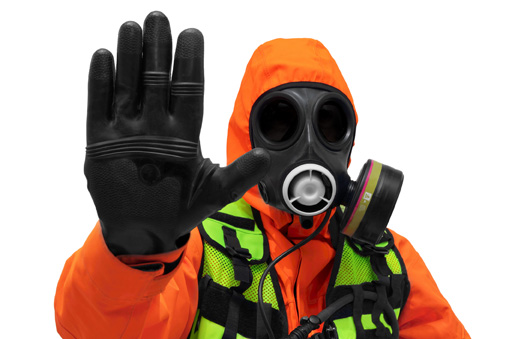
Hazmat training can be extremely beneficial, even compulsory if you are working in a profession that requires you to come into close contact with dangerous substances. For example, anyone working in a profession such as mining, construction, emergency rescue, firefighting, transportation, shipping, waste treatment or disposal could benefit from learning about these safety procedures. Many employers choose to assign their employees to participate in this firefighting course as it minimises their personal risk on-site and helps to protect others. In order to avoid the harmful long-term and short-term effects of exposure to hazardous materials, trainees at EMCARE are taught how to handle hazmat incidents during their firefighting course.
The Fire Fighter 1 SP & Hazmat Awareness SP Course (FF1), Fire Fighter 2 SP & Hazmat Operations SP Course (FF2) and the Hazardous Material Handling Course were all created with the intention of rigorously preparing first responders. A firefighting course educates you on how to survey and classify the intensity of the incident, how to carry out risk assessments, how to use personal protective equipment and how to track the hazardous substance in the environment. It also teaches you how to use appropriate fire equipment effectively, how to consult with a team and implement a response strategy, how to isolate the incident, and how to minimise damages or injuries.
Fire Fighter 1 SP & Hazmat Awareness SP Course (FF1)
This 9-week firefighting course is targeted towards those who wish to dedicate themselves to careers as first responders and professional firefighters. It includes detailed analyses of hazardous materials, their qualities and characteristics. It also includes information regarding the implementation of health and safety procedures according to the relevant South African legislation amongst other subjects such as the handling of personal protective equipment and fire extinguishers, fire control, loss control and rescue tools.
This firefighting course is only available in Polokwane, unless you request that EMCARE presents the course to a group of 20+ people at their own premises. The pre-requisites cite that students must not have claustrophobia or acrophobia. They must possess a fitness declaration, grade 10 qualifications and have a working proficiency in English. Students will be provided with learner manuals, equipment and certificates.
Fire Fighter 2 SP & Hazmat Operations SP Course (FF2)
This firefighting course advances from the foundational knowledge of the level 1 fire fighter course. This 7-week firefighting course focuses more on hazmat operations than hazmat awareness. For example, students of this firefighting course will learn how to operate fire hoses, ropes and fire streams. They will also learn how to determine the cause and origin of fire by analysing the behaviour of fire. Using personal protective equipment, first responders will undergo practice sessions where they must learn to enforce water supply rescue, tactical ventilation, vehicle extrication, victim removal, structural search, forcible entry, and command, safety and scene control amongst other tasks.
Much like the FF1 course, this firefighting course is only available in Polokwane unless you request that EMCARE presents the course to a group of 20+ people at their own premises. Again, the pre-requisites cite that students must not have claustrophobia or acrophobia. They must possess a fitness declaration, grade 10 qualifications and have proficiency in English. Students will be provided with learner manuals, equipment and certificates.
Hazardous Material Handling Course
This 2-day firefighting course is very useful for those who have been tasked with the responsibility of identifying and evaluating the danger of an accident involving hazardous materials. These students will engage more in the awareness level. They will be taught how to recognize hazards, secure the area, take defensive actions and know who to call.
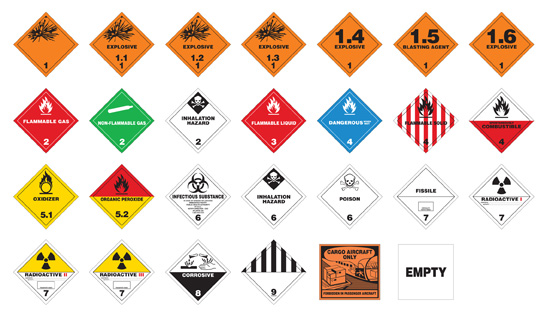
Students of this hazmat firefighting course will be familiarised with the procedures to follow when calling for assistance. Students will learn the basic description and technical name of the hazardous material as well as the basic factors in assessing risk, injury and fire. For example, this course will teach students how to fill in material safety data sheets, how to read transportation markings and labels, and how to check shipping papers and other written resources.
This firefighting course is available at all EMCARE branches. English proficiency is a prerequisite. However, language instructors can be made available under certain conditions. Students will be provided with manuals, equipment and certificates.
Emergency Response
Throughout all of the above courses, students will be taught how to manage a dangerous environment in an emergency situation. These skills are incredibly advantageous as they combine physical strength, mental conviction and speedy, informed decision-making. After a student participates in one of the three hazmat awareness, handling and operations courses, they will be adequately prepared to manage any toxic incident, chemical spill or exposure. Students will learn the following skills overall:
- The technical names and descriptions of different hazardous materials
- The dangers and health hazards that each material poses
- The efficient way to communicate with colleagues and co-firefighters
- The precautions to be considered and implemented in the event of an accident or incident
- The ability to measure the risks of fire or explosion
- The correct methods for handling spills, leaks and fires
- Preliminary first aid measures to take when victims are nearby
Call EMCARE Today
If you want to minimise your risk of exposure to hazardous materials, and protect other people in the process, then these EMCARE courses are for you. These classes will keep you safe and teach you how to efficiently handle any emergency situation involving dangerous substances. Call EMCARE today to book your class and start learning life-saving skills.