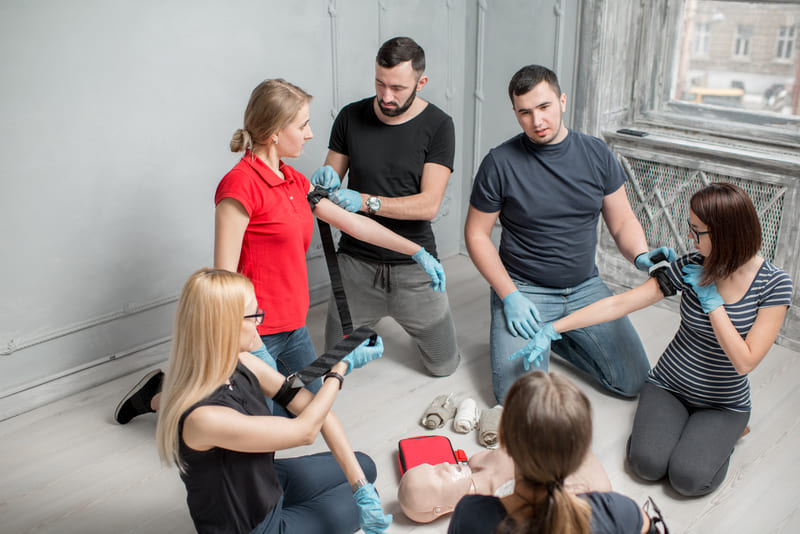
Anyone who wishes to respond appropriately to serious injuries must have first aid training, particularly when it comes to advanced wound management techniques like knowing when to apply tourniquets and pressure dressings. After completing EMCARE’s thorough first aid course, your knowledge will go beyond simple bandaging and identifying potentially fatal haemorrhages. Our first aid course at EMCARE will prepare you for high-risk bleeding situations wherever they occur. In this practical guide, we will discuss the importance of a first aid course and severe wound management.
Severe Bleeding: First Aid Training Saves Lives
Controlling blood loss is your top priority when you come across a casualty who is heavily bleeding. Without the right first aid course experience, hesitation or uncertainty can cost precious time, and severe external bleeding can cause shock in a matter of minutes.
Early bleeding control is one of the most important aspects of trauma care, especially in pre-hospital settings, according to evidence-based guidelines. According to the Australian and New Zealand Committee on Resuscitation, firm pressure on or around a wound is the most effective initial intervention for external bleeding, and it must be applied right away in life-threatening situations.
During your training, you’ll learn how to recognise various forms of bleeding, such as venous and arterial bleeding. Because arterial bleeding is frequently bright red and may spurt rhythmically with each heartbeat, it is particularly dangerous.
You might find it difficult to differentiate between a catastrophic haemorrhage and manageable bleeding if you don’t have formal training through an accredited first aid course. Our in-person training sessions cover Scenario-based exercises, teaching you how to act decisively, protect yourself with the right barriers, and quickly assess the severity of the wound.
Direct Pressure And The Transition To Pressure Dressings
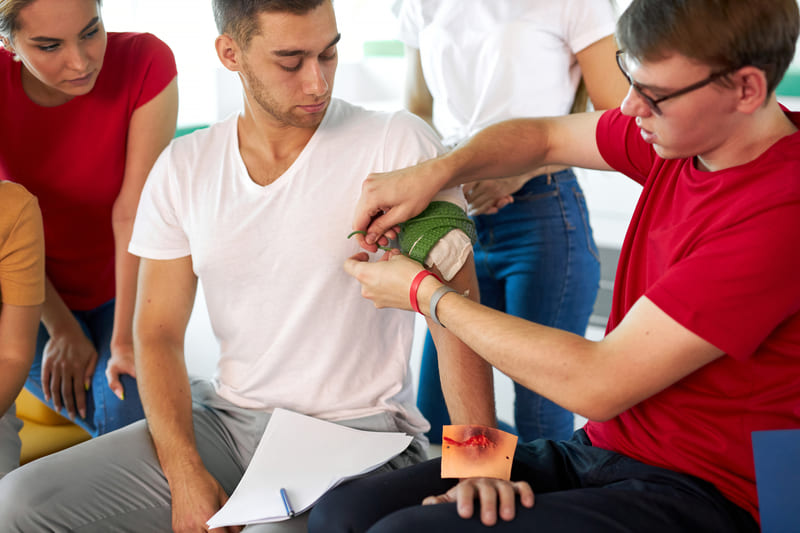
Direct manual pressure is essential when it comes to advanced wound care. During your first aid course, you’ll learn how to use a sterile dressing or clean cloth to apply steady and firm pressure on the wound. This compression prevents blood clots from forming while slowing down blood flow. However, you cannot sustain manual pressure indefinitely.
The purpose of pressure dressing is to keep a wound continuously compressed without requiring your hands to stay in place. During your first aid course, you will practice covering the bleeding site with an absorbent pad and, thereafter, wrapping firmly with a bandage. Maintaining sufficient pressure to stop bleeding while still permitting blood flow outside the dressing is what you should aim for. When direct pressure is insufficient to maintain haemostasis, pressure dressings are very useful, according to first responder clinical manuals used in emergency medicine education.
Your first aid course experience ensures you understand when to escalate from manual pressure to a pressure dressing. For example, if bleeding resumes the moment you release your hand, or if you must manage additional injuries, applying a properly secured pressure dressing is appropriate.
You also learn not to remove the initial dressing if blood soaks through, but rather to reinforce it with additional layers while maintaining compression. These nuances are repeatedly reinforced in first aid training so that your response becomes instinctive rather than uncertain. In moments of panic, hesitation can be deadly.
Integrating Advanced Techniques Into Real-World Response
Tourniquets should only be used in cases of severe bleeding from the arms or legs. The head, neck, chest, or abdomen should never be treated with them. At EMCARE, you will learn to place the tourniquet between the injury and the heart, several centimetres above the wound, and away from joints.
The time of application must be noted and reported to emergency medical services, and the device must be tightened until the bleeding stops. Tourniquets must be applied correctly, and only highly qualified medical professionals should remove them.
Thereafter, you will learn how to use commercial tourniquets and make your own ones in a controlled setting through structured first aid training. This hands-on experience will boost your confidence, allowing you to act without hesitation. If you don’t get hands-on training, you might hesitate or use the device incorrectly. EMCARE’s training ensures you understand the pros and cons of using a tourniquet, as well as the risk of tissue damage if it is left in place for too long.
Advanced wound care requires using more than one technique at a time. Good first aid or medical emergency training teaches you how to use pressure dressings, tourniquets, and haemostatic agents in a logical order. For instance, you start with direct pressure, move on to a pressure dressing if necessary, and then use a tourniquet if the bleeding in the limb can’t be stopped. This ordered response ensures that you use the least invasive yet most effective intervention for the situation.
EMCARE’s first aid course will also teach you how to communicate and work with other people during emergencies. When you respond to someone who is bleeding heavily, you need to calm them down, look for signs of shock, and make sure that emergency services are called. Our course covers how to properly position the injured person, keep them warm, and keep checking on their wounds. These skills are part of a full first aid training course so that you can respond in a planned way instead of just reacting.
When direct pressure and regular dressings aren’t enough, especially on wounds where a tourniquet can’t be used, academic and humanitarian first aid guidelines say that haemostatic dressings should be used. You will learn about these special materials and how to pack and secure them correctly during the advanced first aid course training scenario role play. This additional knowledge ensures that you are prepared for complex scenarios.
Take The Next Step, Train With EMCARE
One of the best things about EMCARE’s structured first aid training is that it makes you feel confident. It’s not enough to have theoretical knowledge. You need to do things, practice skills repeatedly, while an expert observes and corrects any mistakes. As part of EMCARE’s first aid course, you will have to prove your knowledge of pressure dressings and tourniquets, as well as how to use them correctly while being timed.
These drills are like real emergencies, which help you stay calm and focused. At EMCARE, you will be guided by industry experts while learning the most relevant techniques regarding severe wound care. If you are ready to make a difference, visit the EMCARE website and browse our selection of certified courses. When faced with an emergency, you can be the difference between life and death.